


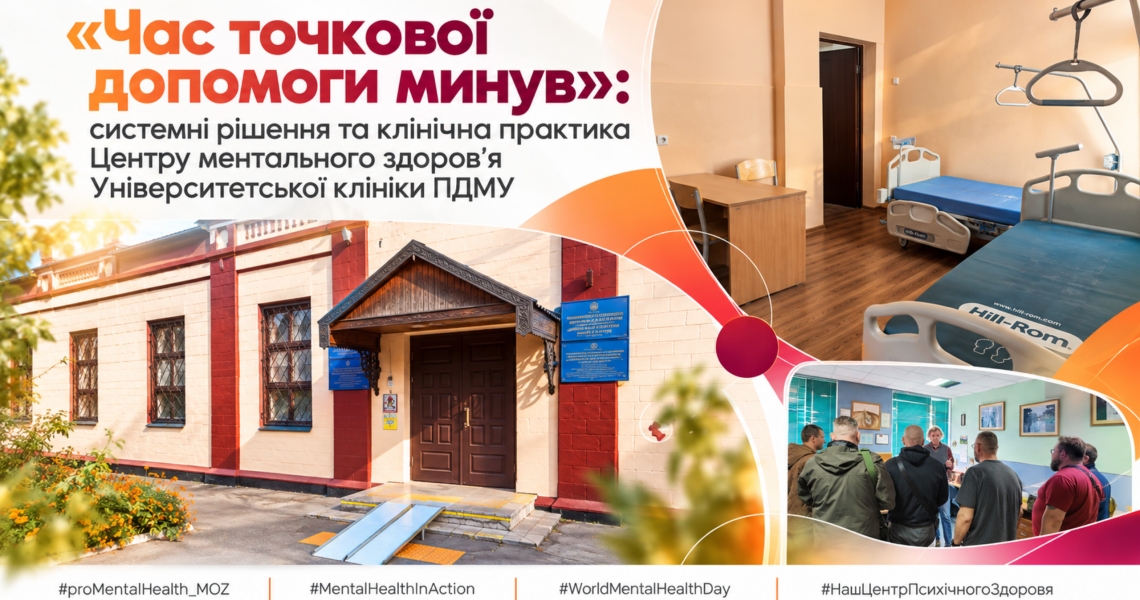
Днями, 10 жовтня, світ відзначив Всесвітній день психічного здоров’я. Це важливе нагадування: ментальне здоров’я – це наша здатність жити, долати труднощі та знаходити сили рухатися вперед. В умовах війни турбота про нього є не розкішшю, а життєвою необхідністю.
Цьогоріч колеги із Центрів психічного здоров’я, які працюють саме в українських лікарнях, ініціювали всеукраїнський флешмоб. Полтавський державний медичний університет має розгалужену систему психологічної підтримки, але сьогодні, відповідаючи на цей заклик, ми хочемо розповісти про наш клінічний підрозділ – Центр ментального (психічного) здоров’я, який діє безпосередньо на базі Навчально-науково-лікувального підрозділу «Університетська клініка» ПДМУ.
Далі ділиться досвідом керівник Центру Вадим Рудь:
– У контексті Всесвітнього дня психічного здоров’я я хочу поговорити про те, що стало для нас питанням виживання та стійкості нації. Я доцент кафедри психіатрії, наркології та медичної психології, кандидат медичних наук і маю честь очолювати цей Центр. Підтримуючи ініціативу колег, я хочу відверто розповісти про наші будні: з якими викликами ми стикаємося щодня і як університетська наука допомагає нам лікувати та підтримувати людей.
Хто наші пацієнти та з якими викликами ми стикаємося
Щодня ми бачимо, як війна залишає глибокі шрами на психіці людей. Близько 60% наших пацієнтів – це військові та члени їхніх родин (дружини, матері, молоді люди віком від 18 років). Ще 40% – цивільне населення.
Час точкової допомоги та телефонів довіри минув – вони вичерпали свій ресурс ще у 2022 році. Сьогодні ми маємо справу з глибоко виснаженими адаптаційними ресурсами, хронічними формами ПТСР та соматизацією психічних розладів. Наші реалії – це «невизначена втрата», коли до нас звертається жінка, син якої понад рік вважається зниклим безвісти. Це важкі потрійні коморбідності, коли військовий має одночасно наслідки органічного ураження головного мозку, прояви ПТСР та хімічну залежність, або ж тотальні порушення сну, від яких страждають як захисники, так і цивільні.
Наука на службі здоров'я: наша команда та підхід
Один лікар такі складні стани не подужає. Саме тому ми зробили ставку на системність, мультидисциплінарність та академічний досвід. У нашому Центрі працює потужна команда науковців і практиків – представників кафедри психіатрії, наркології та медичної психології ПДМУ. Разом зі мною працюють:
Володимир Борисенко – доцент кафедри, кандидат медичних наук. Він відповідає за психосоціальну індивідуальну та групову допомогу, а також психотерапевтичну підтримку.
Олексій Казаков – асистент кафедри, кандидат медичних наук, практикуючий лікар-психіатр.
Дмитро Бойко – лікар-психотерапевт та сомнолог, який професійно займається розв'язанням вкрай актуальної проблеми порушень сну (інсомнії).
Та, звісно, наші незамінні медичні сестри.
Ми активно залучаємо до роботи сімейних лікарів (за програмою mhGAP), неврологів та лікарів ФРМ. Лише з початку лютого ми надали амбулаторну допомогу 237 пацієнтам, здійснили 17 виїздів мобільної команди та залучили 78 людей до психотерапевтичного процесу. Крім того, з початку 2023 року при нашому Центрі успішно діє одна з перших в Україні груп взаємодопомоги для ветеранів з ПТСР, яка працює за принципом груп анонімної підтримки.
Стигма зникає: чому не варто боятися
Раніше, коли я заходив у палату до військових і казав, що я психіатр, хлопці занурювалися у свої мобільні телефони і казали: «У нас проблем немає». А потім один за одним виходили за мною, щоб поговорити наодинці. Зараз цей страх і рівень стигматизації знижуються.
Якщо людина вела нездоровий спосіб життя і заробила гіпертонію – їй не соромно йти до кардіолога. То чому має бути соромно звернутися по допомогу після важкої психічної травми, втрати побратима чи загрози власному життю? Звернення до психіатра, психотерапевта чи клінічного психолога – це не ознака слабкості.
Що надихає нашу команду працювати навіть у вихідні? Усвідомлення того, що ми допомагаємо Україні. Наша робота тут, у тилу – не менш важлива, ніж робота інших структур, і ми як представники медичної спільноти ПДМУ готові до викликів, які стоять перед суспільством.
Одному подолати проблему важко. Але пам'ятайте, що завжди є плече підтримки. Не бійтеся звертатися до фахівців.
З повагою,
Директор Центру ментального (психічного) здоров’я ННЛП «Університетська клініка» ПДМУ,
доцент кафедри психіатрії, наркології та медичної психології, кандидат медичних наук
Вадим Олексійович Рудь
Контактна інформація для запису та консультацій:
Телефон: +38 (050) 641-69-32
E-mail: v.rud@pdmu.edu.ua
Графік роботи: Пн–Пт з 08:00 до 17:00 (субота та неділя – вихідні)
Адреса: м. Полтава, вул. Небесної Сотні, 77
Пресслужба Полтавского державного медицинского университета
“The Time for One-Off Interventions Is Over”: Systemic Solutions and Clinical Practice at the Mental Health Center of PSMU University Clinic
#proMentalHealth_MOZ
#MentalHealthInAction
#WorldMentalHealthDay
#OurMentalHealthCenter
On October 10, the world marked World Mental Health Day. This important occasion reminds us that mental health is our ability to live, overcome difficulties, and find the strength to move forward. In wartime, caring for mental health is not a luxury but a vital necessity.
This year, colleagues from mental health centers operating within Ukrainian hospitals initiated a nationwide awareness campaign. Poltava State Medical University (PSMU) has an extensive system of psychological support services. In response to this initiative, we would like to highlight one of our clinical units: the Mental Health Center, which operates directly within PSMU’s Educational, Research, and Clinical Unit, the University Clinic.
The Center’s Director, Vadym Rud, shares his experience below.
Who We Are and Why This Work Matters
In the context of World Mental Health Day, I would like to discuss an issue that has become a matter of our nation’s survival and resilience. I am an Associate Professor at the Department of Psychiatry, Narcology, and Medical Psychology, hold a PhD in Medicine, and have the honor of heading this Center.
In support of my colleagues’ initiative, I would like to speak openly about our everyday work: the challenges we face and how university research and academic expertise help us treat and support people.
Who Our Patients Are and the Challenges We Face
Every day, we witness the deep psychological scars left by the war. Approximately 60% of our patients are military personnel and their family members, including wives, mothers, and young adults aged 18 and older. The remaining 40% are civilians.
The time for one-off interventions and telephone helplines has passed; these resources had already reached their limits by 2022. Today, we are dealing with severely depleted adaptive capacities, chronic forms of post-traumatic stress disorder (PTSD), and the somatization of mental disorders.
Our daily reality includes ambiguous loss—for example, when a woman comes to us because her son has been missing for more than a year. We also encounter severe cases involving multiple co-occurring conditions, such as a servicemember simultaneously experiencing the consequences of an organic brain injury, PTSD symptoms, and substance dependence. Another pressing issue is pervasive sleep disturbance, affecting both military personnel and civilians.
Science in the Service of Health: Our Team and Approach
One physician cannot manage such complex conditions alone. That is why we have focused on a systematic, multidisciplinary approach supported by academic expertise.
Our Center brings together a strong team of researchers and practitioners from PSMU’s Department of Psychiatry, Narcology, and Medical Psychology. My colleagues include:
- Volodymyr Borysenko, Associate Professor and PhD in Medicine, who is responsible for individual and group psychosocial support, as well as psychotherapeutic care.
- Oleksii Kazakov, Assistant Lecturer, PhD in Medicine, and practicing psychiatrist.
- Dmytro Boiko, psychotherapist and sleep medicine specialist, who focuses on addressing the particularly pressing problem of sleep disorders, including insomnia.
And, of course, our indispensable nursing staff.
We also actively involve family physicians through the mhGAP programme, as well as neurologists and physical and rehabilitation medicine specialists.
Since the beginning of February alone, we have provided outpatient care to 237 patients, conducted 17 mobile team visits, and involved 78 people in psychotherapy.
Furthermore, since early 2023, our Center has successfully operated one of Ukraine’s first mutual support groups for veterans with PTSD, based on the principles of anonymous peer-support groups.
Breaking the Stigma: Why There Is No Need to Be Afraid
In the past, when I entered a hospital ward to speak with military personnel and introduced myself as a psychiatrist, the guys would bury themselves in their mobile phones and say, “We don’t have any problems.” Then, one by one, they would follow me out to speak privately.
Today, this fear and the level of stigma surrounding mental health care are decreasing.
If someone has led an unhealthy lifestyle and developed hypertension, they do not feel ashamed to consult a cardiologist. So why should anyone feel ashamed to seek help after experiencing severe psychological trauma, losing a fellow servicemember, or facing a threat to their own life?
Seeking help from a psychiatrist, psychotherapist, or clinical psychologist is not a sign of weakness.
What motivates our team to keep working, even on weekends? It is the knowledge that we are helping Ukraine. Our work here on the home front is no less important than the work of other organizations and services. As members of the PSMU medical community, we are ready to meet the challenges facing our society.
It is difficult to overcome these challenges alone. But remember: there is always someone ready to support you. Do not be afraid to seek professional help.
With respect,
Vadym Oleksiiovych Rud
Director of the Mental Health Center,
Educational, Research, and Clinical Unit “University Clinic,” PSMU
Associate Professor, Department of Psychiatry, Narcology, and Medical Psychology
PhD in Medicine
Contact Information for Appointments and Consultations
Phone: +38 (050) 641-69-32
Email: v.rud@pdmu.edu.ua
Working hours: Monday–Friday, 08:00–17:00 (closed on Saturdays and Sundays)
Address: 77 Nebesnoi Sotni Street, Poltava, Ukraine