


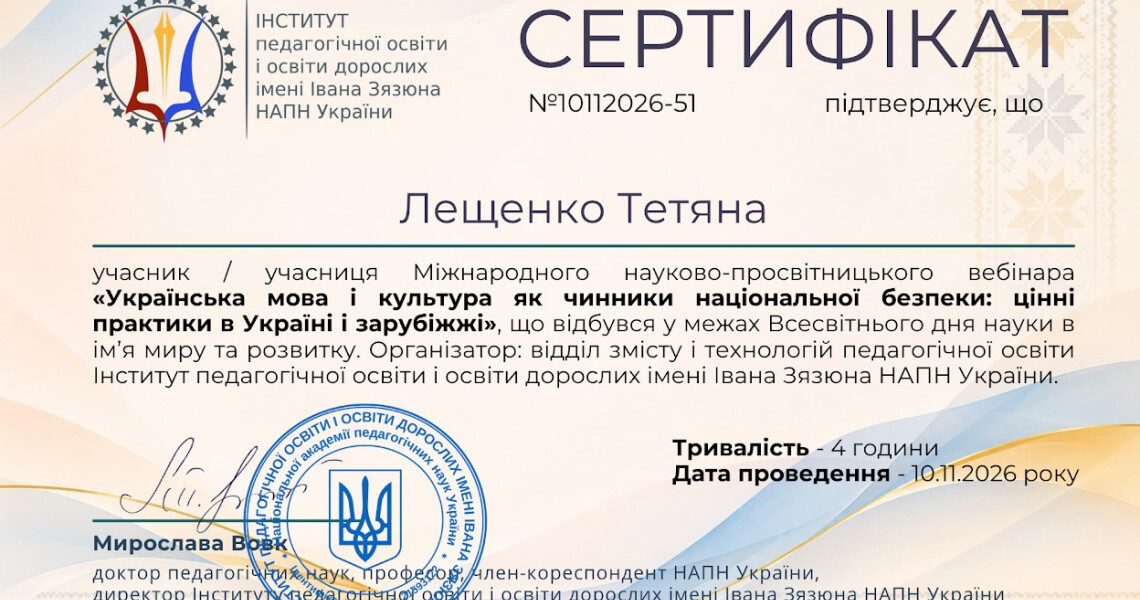
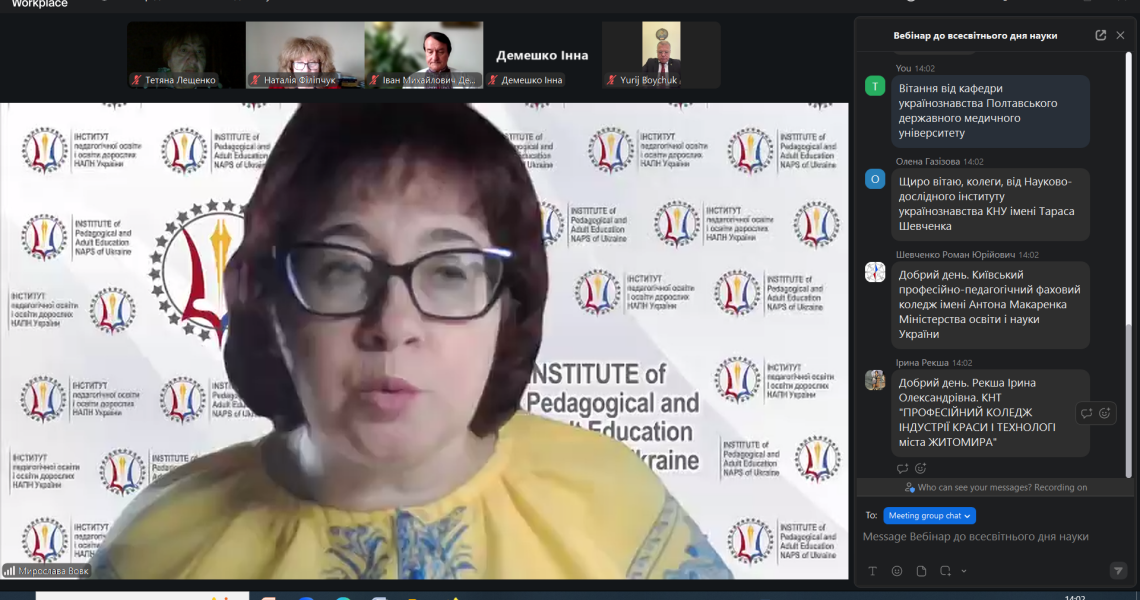
Завідувачка кафедри українознавства та гуманітарної підготовки ПДМУ Тетяна Лещенко взяла участь у міжнародному науково-просвітницькому вебінарі «Українська мова і культура як чинники національної безпеки: цінні практики в Україні і зарубіжжі». Захід відбувся 10 листопада 2026 року, у Всесвітній день науки в ім’я миру та розвитку.
Організатором вебінару виступив відділ змісту і технологій педагогічної освіти Інституту педагогічної освіти і освіти дорослих імені Івана Зязюна НАПН України. До організації також долучилися українські університети, освітні й наукові установи, кафедра ЮНЕСКО «Неперервна професійна освіта ХХІ століття» НАПН України, Управління Державної служби якості освіти у Чернівецькій області та Всеукраїнське товариство «Просвіта» імені Тараса Шевченка.
Особливістю вебінару стало поєднання наукового, освітнього, дипломатичного й культурного вимірів обговорення, а також представлення міжнародного досвіду збереження та популяризації української мови.
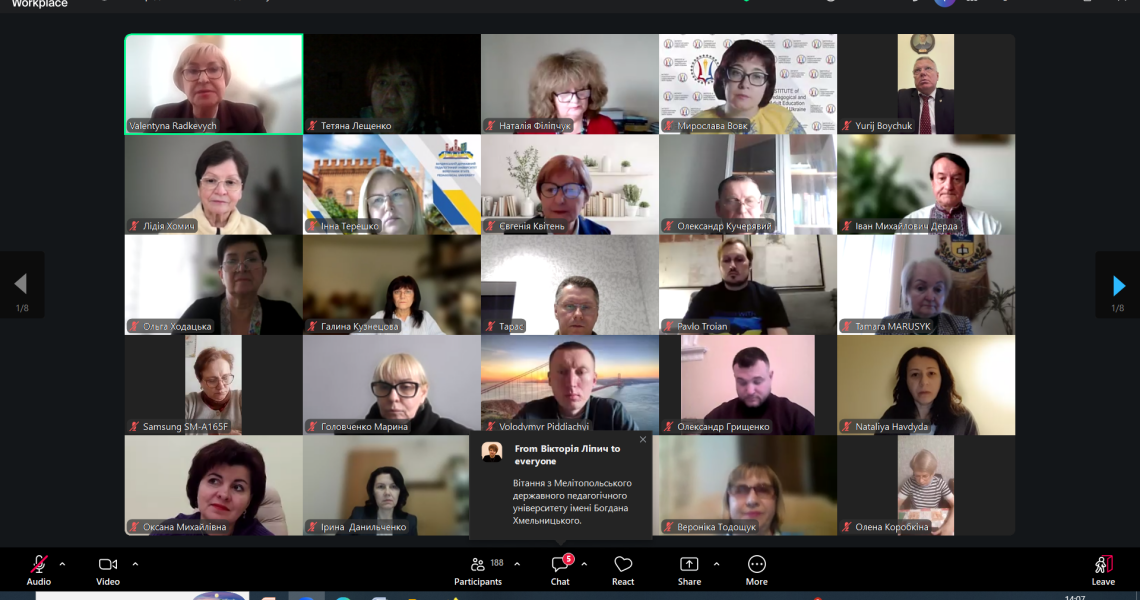
На вебінарі були присутні 258 учасників, які представляли 30 закладів вищої освіти, 15 закладів фахової передвищої та професійної освіти, 13 закладів загальної середньої та дошкільної освіти, 4 наукові установи, а також 6 інших освітніх, методичних і культурно-освітніх установ, 3 громадські та культурно-освітні організації й органи державного управління освітою. Міжнародний вимір заходу охопив Україну, США, Польщу, Австралію, Чехію, Францію та Італію – завдяки участі закордонних доповідачів, представників дипломатичних і культурно-освітніх осередків та зареєстрованих учасників.
Ця широка географія ще раз засвідчила, що питання збереження й розвитку української мови виходить далеко за межі національного освітнього простору й об’єднує українські спільноти в різних куточках світу. Було наголошено, що мова –– це значно більше, ніж засіб спілкування. Це наша історична пам’ять, культурна ідентичність, інструмент міжнародної присутності та один із фундаментальних чинників національної стійкості. У виступах було підкреслено, що в умовах російсько-української війни українська мова і культура є не лише складниками національної спадщини, а й важливими ресурсами суспільної згуртованості, громадянської свідомості та державної стійкості. Особливу роль у цьому процесі відіграють освіта, наука, культурно-просвітницькі ініціативи і взаємодія з українськими громадами в різних країнах світу. У виступах і дискусіях обговорювалися гостро актуальні питання: як зберегти українську мову в умовах глобальної міграції? Яким має бути її майбутнє в європейському освітньому просторі? Як українські громади за кордоном підтримують національну ідентичність? Чому питання мовної освіти сьогодні безпосередньо пов’язане з національною безпекою України?
Міжнародний характер заходу підкреслила участь представників дипломатичних установ України, зокрема Павла Трояна – першого секретаря Посольства України в Австралії, куратора Нової Зеландії та острівних країн Тихого океану, який висвітлив досвід українських громад Австралії та Нової Зеландії, які впродовж десятиліть зберігають національну ідентичність через діяльність українських шкіл, культурних осередків, громадських об’єднань і медіа. Обговорено потребу в сучасних навчальних матеріалах, гнучких методиках, культурному зануренні та поєднанні мовної підготовки з вивченням українських традицій, історії й сучасної культури.
Надзвичайно цікавим став практичний досвід, представлений Наталією Гавдидою – кандидаткою філологічних наук, доценткою, членкинею Вашингтонського осередку Наукового товариства імені Шевченка, викладачкою програми Learn Ukrainian Language Program в Ukraine House (Вашингтон, округ Колумбія), представницею української мови в Коаліції шкіл успадкованих мов (Coalition of Community-Based Heritage Language Schools) у США. Її доповідь була присвячена викладанню української мови як іноземної та успадкованої – тобто мови, яку діти й дорослі опановують або зберігають у родинах українського походження за межами України. Особливий інтерес викликали практики навчання різних категорій слухачів, зокрема нащадків українських емігрантів, членів змішаних родин, дипломатів та іноземців, які прагнуть вивчати українську мову.
Павел Левчук – доцент Інституту славістики Польської академії наук (Республіка Польща) – представив доповідь «Майбутнє української мови у Європі: статус, викладання та сертифікація». Науковець проаналізував сучасне становище української мови в європейському освітньому просторі, зокрема питання її викладання, визнання мовних компетентностей, сертифікації та підготовки педагогів. У центрі уваги – необхідність розвитку якісних навчальних матеріалів, створення доступних можливостей для вивчення української мови та системної підтримки україномовної освіти за кордоном. Важливим акцентом стала думка про те, що поширення української мови у світі має розглядатися не лише як ініціатива окремих громад, а й як довгостроковий напрям державної освітньої та культурної політики.
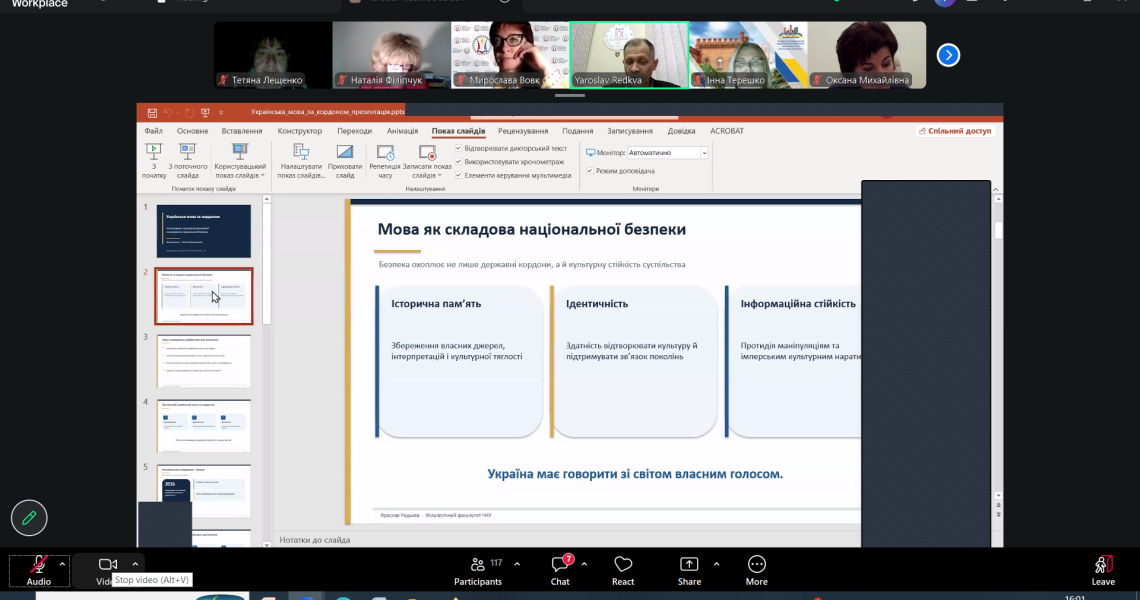
Ярослав Редьква – декан філологічного факультету Чернівецького національного університету імені Юрія Федьковича – розкрив тему «Українська мова за кордоном як інструмент культурної дипломатії та зміцнення національної безпеки». Доповідач представив приклади міжнародної університетської співпраці з партнерами з Польщі, Хорватії та Словаччини, зокрема розвиток українознавчих студій, спільних досліджень і освітніх програм. Наголошено на необхідності підтримки української мови в іноземних університетах, підготовки викладачів, розвитку цифрових освітніх ресурсів і створення умов для збереження мовної ідентичності українських родин за кордоном.
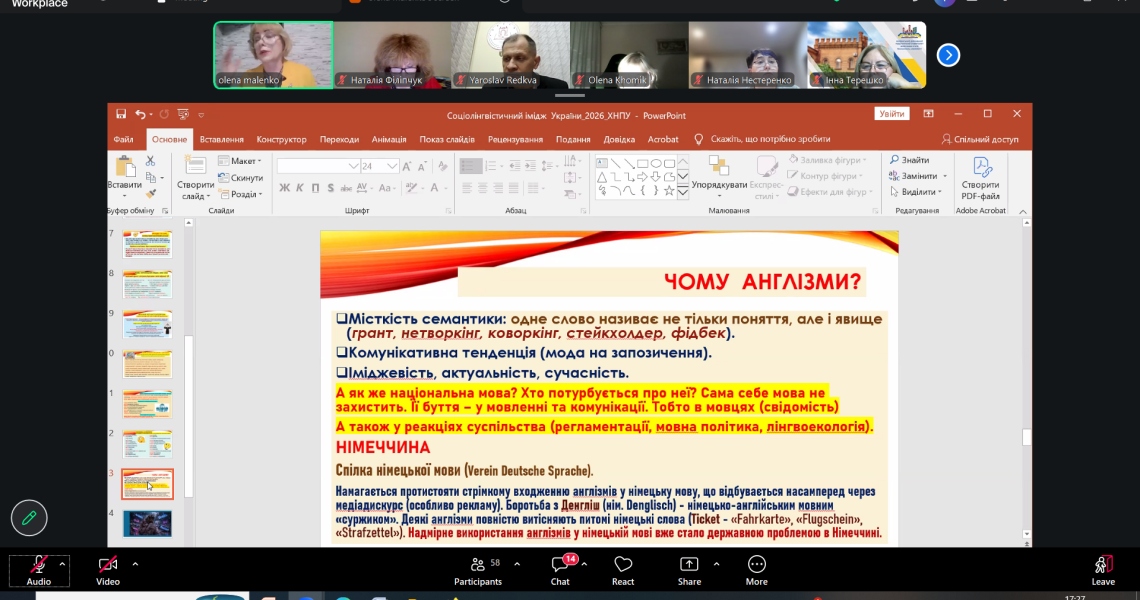
Важливий науковий аспект дискусії представила Олена Маленко – доктор філологічних наук, професор, завідувач кафедри українознавства і лінгводидактики імені професора О. Г. Муромцева Харківського національного педагогічного університету імені Г. С. Сковороди. Її доповідь «Українська мова у викликах лінгвоекології» була присвячена сучасним процесам розвитку мовного середовища, впливу глобалізації, іншомовних запозичень та поширення англомовної термінології в медіа, освіті й повсякденному спілкуванні. Обговорення засвідчило важливість відповідального ставлення до мовної культури, розвитку мовної свідомості та збереження виражальних можливостей української мови в умовах інтенсивної міжнародної комунікації.
Учасники вебінару наголосили, що збереження й розвиток української мови та культури потребують спільних зусиль держави, наукової й освітньої спільнот, дипломатичних установ, громадських організацій та українців за кордоном.
Пресслужба Полтавского державного медицинского университета
Ukrainian Language and Culture as Pillars of National Security: PSMU Representative Takes Part in International Webinar
Tetiana Leshchenko, Head of the Department of Ukrainian Studies and Humanitarian Training at Poltava State Medical University (PSMU), took part in the international academic and educational webinar “Ukrainian Language and Culture as Factors of National Security: Valuable Practices in Ukraine and Abroad”. The event was held on 10 November 2026, on World Science Day for Peace and Development.
The webinar was organized by the Department of Content and Technologies of Teacher Education of the Ivan Ziaziun Institute of Pedagogical and Adult Education of the National Academy of Educational Sciences of Ukraine. Ukrainian universities, educational and research institutions, the UNESCO Chair “Lifelong Professional Education in the 21st Century” of the National Academy of Educational Sciences of Ukraine, the Department of the State Education Quality Service of Ukraine in Chernivtsi Region, and the All-Ukrainian Society “Prosvita” named after Taras Shevchenko also contributed to its organization.
A distinctive feature of the webinar was its integration of academic, educational, diplomatic and cultural perspectives, as well as the presentation of international experience in preserving and promoting the Ukrainian language.
The webinar brought together 258 participants representing 30 higher education institutions, 15 vocational pre-higher and vocational education institutions, 13 general secondary and preschool education institutions, four research institutions, six other educational, methodological and cultural institutions, three public and cultural-educational organizations, and education authorities. The international dimension of the event extended across Ukraine, the United States, Poland, Australia, the Czech Republic, France and Italy, thanks to the participation of international speakers, representatives of diplomatic and cultural-educational centers, and registered attendees.
This broad geographical reach once again demonstrated that the preservation and development of the Ukrainian language extend far beyond the national educational space and unite Ukrainian communities around the world. It was emphasized that language is much more than a means of communication: it embodies historical memory and cultural identity, serves as an instrument of international presence and constitutes one of the fundamental factors of national resilience.
The speakers highlighted that, amid the russian-Ukrainian war, the Ukrainian language and culture are not merely components of national heritage but also important resources for social cohesion, civic awareness and state resilience. Education, science, cultural and educational initiatives, and engagement with Ukrainian communities in different countries play a particularly important role in this process.
The presentations and discussions addressed pressing questions: How can the Ukrainian language be preserved amid global migration? What should its future be in the European educational space? How do Ukrainian communities abroad maintain their national identity? Why is language education now directly linked to Ukraine’s national security?
The international character of the event was underscored by the participation of representatives of Ukraine’s diplomatic missions. Among them was Pavlo Troian, First Secretary of the Embassy of Ukraine in Australia, responsible for New Zealand and the Pacific Island countries. He spoke about the experience of Ukrainian communities in Australia and New Zealand, which have preserved their national identity for decades through Ukrainian schools, cultural centers, community associations and media. The discussion highlighted the need for up-to-date learning materials, flexible teaching methods, cultural immersion, and the integration of language learning with the study of Ukrainian traditions, history and contemporary culture.
Particularly interesting was the practical experience presented by Nataliia Havdyda, PhD in Philological Sciences, Associate Professor, member of the Washington branch of the Shevchenko Scientific Society, instructor of the Learn Ukrainian Language Program at Ukraine House in Washington, D.C., and representative of the Ukrainian language in the Coalition of Community-Based Heritage Language Schools in the United States.
Her presentation focused on teaching Ukrainian as a foreign and heritage language – that is, a language that children and adults of Ukrainian descent learn or maintain within their families outside Ukraine. Of particular interest were teaching practices tailored to different groups of learners, including descendants of Ukrainian emigrants, members of mixed families, diplomats and foreigners wishing to learn Ukrainian.
Pavel Levchuk, Associate Professor at the Institute of Slavic Studies of the Polish Academy of Sciences (Poland), delivered a presentation entitled “The Future of the Ukrainian Language in Europe: Status, Teaching and Certification”. He analyzed the current position of Ukrainian in the European educational space, focusing on language teaching, recognition of language competencies, certification and teacher training. Particular attention was paid to the need to develop high-quality learning materials, create accessible opportunities for studying Ukrainian and provide systematic support for Ukrainian-language education abroad. An important point was that promoting the Ukrainian language worldwide should be regarded not merely as an initiative of individual communities but as a long-term priority of national educational and cultural policy.
Yaroslav Redkva, Dean of the Faculty of Philology at Yuriy Fedkovych Chernivtsi National University, explored the topic “The Ukrainian Language Abroad as an Instrument of Cultural Diplomacy and Strengthening National Security”. He presented examples of international university cooperation with partners in Poland, Croatia and Slovakia, including the development of Ukrainian studies, joint research and educational programs. He emphasized the importance of supporting the Ukrainian language at foreign universities, training teachers, developing digital educational resources and creating conditions for Ukrainian families abroad to preserve their linguistic identity.
An important academic perspective was offered by Olena Malenko, Doctor of Philological Sciences, Professor and Head of the Professor O. H. Muromtsev Department of Ukrainian Studies and Language Teaching Methodology at H. S. Skovoroda Kharkiv National Pedagogical University. Her presentation, “The Ukrainian Language and the Challenges of Linguistic Ecology”, examined contemporary developments in the linguistic environment and the impact of globalization, foreign-language borrowings and the growing use of English-language terminology in the media, education and everyday communication. The discussion highlighted the importance of a responsible attitude towards language culture, the development of linguistic awareness and the preservation of the expressive potential of the Ukrainian language amid intensive international communication.
The webinar participants emphasized that preserving and developing the Ukrainian language and culture requires joint efforts by the state, academic and educational communities, diplomatic missions, public organizations and Ukrainians living abroad.